
Why Enterprise Cybersecurity Stacks Are Still Failing
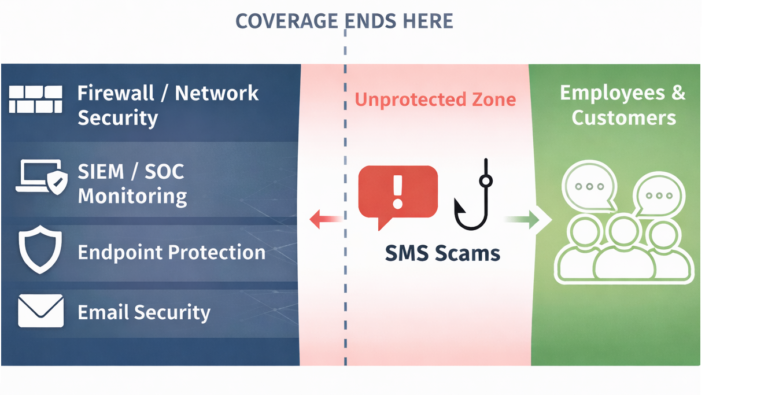
Enterprise cybersecurity programs are more mature than ever, yet SMS threat detection for enterprises remains largely absent from most security stacks.
Organizations rely on EDR, SIEM, email security, and endpoint protection to reduce risk — but SMS-based phishing and brand impersonation attacks routinely bypass these controls. The result is a growing enterprise SMS security gap that contributes to breaches averaging $9.36 million per incident.
This is not a failure of execution.
It’s a failure of coverage.
Why SMS Threats Are So Effective Against Enterprises, Banking and Financial Services

SMS was built for speed and trust — not security. That makes it uniquely effective for fraud. Research from the Global Anti-Scam Alliance (GASA) shows:
- 70% of adults globally encountered a scam in the past year
- Around one in ten people experience scam attempts daily
- 64% of scams succeed within 24 hours, with nearly half succeeding within minutes
For enterprises, this means SMS attacks often succeed before traditional detection or response processes activate.
Compounding the problem:
- SMS reaches personal devices, including BYOD
- Messages require no authentication to deliver
- Most enterprise security tools do not inspect SMS content in real time
This creates a critical exposure point for enterprises trying to protect employees, customers, and brand trust. Most enterprise security stacks never see SMS.
How Attackers Intentionally Bypass Enterprise Security
Modern fraud campaigns are engineered to avoid enterprise defenses entirely.
Brian Krebs (Krebs on Security) documents how attackers deliberately shift to SMS and other direct communication channels because they fall outside traditional enterprise visibility.
Common attacker behaviors include:
- Brand impersonation via SMS to exploit trust
- Targeting customers rather than employees
- Avoiding monitored corporate infrastructure
Operating at an industrial scale using automation and AI
The takeaway is simple:
Attackers go where enterprise security tools aren’t.
What Effective SMS Threat Detection for Enterprises Requires
Closing the SMS security gap requires more than another internal security control. It requires a customer-deployable security layer designed to operate beyond the enterprise boundary, where SMS fraud actually occurs.
Effective SMS threat detection for enterprises must be built for a B2B2C distribution model, enabling organizations to extend real-time protection not only to employees, but directly to customers and end users — without apps, onboarding, or support overhead.
Effective enterprise SMS threat detection includes:
- Sub-minute analysis of suspicious SMS messages at the moment they are received
- AI-driven detection across message content, embedded links, sender behavior, and attack patterns
- Zero-friction workflows that work on any device or carrier, requiring no installs, logins, or enrollment
- Centralized visibility into attacks targeting both internal users and customers
- Active disruption of malicious infrastructure, not just alerts or post-incident reporting
- No customer support burden, allowing protection to scale to millions of end users
This model shifts protection earlier in the attack chain—before a click, reply, or payment—while allowing enterprises to protect the people attackers deliberately target beyond traditional security controls.
As fraud shifts from systems to people, security must shift from internal controls to customer-facing, B2B2C distribution models that extend protection wherever communication occurs.
Independent research shows scams are frequent and fast.
Investigative reporting shows attackers intentionally bypass enterprise controls.
Together, they validate a clear shift:
Enterprises need security controls that protect people, not just systems.
That’s why the enterprise messaging security platform is emerging as a new category and SMS threat detection for is the first and most urgent layer.
According to the Global Anti-Scam Alliance, more than 70% of adults globally encountered a scam in the past year — underscoring how
pervasive fraud has become across trusted communication channels.
See Enterprise SMS Threat Detection in Action
SMS threats are accelerating, driven by AI and rich messaging.
Waiting just increases your exposure.
CheckTxt is the first product built on the CheckTrust platform. It delivers real-time SMS fraud detection through a zero-friction workflow that works on any device, with no app downloads, logins, or onboarding required. Customers simply forward a suspicious text or submit a screenshot and receive a clear fraud verdict in under 60 seconds. By stopping SMS scams at the moment people decide whether to trust a message, CheckTxt helps organizations prevent fraud, reduce customer harm, and protect brand trust.
 Schedule a demo to see how enterprise-grade SMS threat detection and our messaging security platform works in real time and how easily it integrates with your existing security stack to close one of today’s most costly blind spots.
See how CheckTxt works now >>
Send a screen shot or forward a suspicious text to [442-432-5898] for an instant fraud verdict.
No app. No login. Just forward.
![Send a screenshot or forward a suspicious text to [442-432-5898] for an instant fraud verdict. No app. No login. Just forward.](https://checktxt.com/wp-content/uploads/2025/10/How-to-check-SMS-messages-for-fraud-1024x476.png)