
Customer-Facing SMS Fraud Protection for Banks & Financial Institutions
CheckTxt extends fraud protection into customer communications — where impersonation scams exploit trust in real time.
Built for banks and financial institutions
No other security tool operates where SMS fraud actually happens — in customer’s messages.
CheckTxt complements your existing fraud and security controls by operating where they can’t — directly inside the messages your customers receive. No apps, onboarding, or workflow changes required.
The threat has shifted to your customer
Outside the enterprise stack.
Inside customer communications.
AI-generated messages and RCS-enhanced formats are making SMS impersonation attacks more convincing and harder to detect — mimicking your brand, exploiting customer trust, and adapting in real time. By the time your internal systems detect the pattern, your customers have already acted on the message.
Built for the Problems Banks Actually Have
The gaps in your security stack are where your customers get hit. Here’s how CheckTxt closes them.
By the time you detect the fraud, your customer has already acted on the message.
CheckTxt analyzes suspicious messages at the moment they're received — returning a verdict in under 60 seconds, before any money moves.
You're seeing isolated incidents after the fact. Attackers come in coordinated campaigns.
CheckTxt correlates submissions across your entire customer base, so your fraud team sees active impersonation campaigns while they're still forming — not after losses accumulate.
Reimbursement after the fact isn't the proactive protection regulators expect.
CheckTxt gives you a documented, customer-facing fraud prevention layer — reducing liability exposure and demonstrating the proactive steps regulators are looking for.
Where Your Current Stack Falls Short — And How CheckTxt Covers Them
CheckTxt fills the gap your existing security controls don’t see
CheckTxt enables detection at message receipt. Suspicious SMS messages submitted by customers are analyzed in real time for impersonation and fraud signals, returning a verdict in under 60 seconds. Bank impersonation attacks are specifically engineered to bypass the controls banks already have in place. Learn how bank impersonation attacks work and why they reach customers before existing systems can respond. Learn how bank impersonation attacks work and why they reach customers before existing systems can respond.
Real-time visibility into when customers are being targeted, by whom, and at what scale. Submitted messages are correlated across the customer base to identify emerging impersonation patterns. This shared intelligence layer allows banks to recognize active campaigns while they are still forming — not after losses accumulate.
Real-time visibility into emerging patterns enables proactive customer advisories during live impersonation campaigns. Earlier awareness reduces fraud exposure and limits downstream impact.
No apps, enrollment, or workflow changes are required. Customers simply forward suspicious messages for verification, making protection easy to use on any device.
Stops SMS impersonation campaigns that damage customer confidence and trust. Demonstrates proactive steps to protect customers—reducing regulatory risk and preserving customer trust.
Your customers learn to recognize scams when they encounter one, not when your next campaign goes out.
Live Admin Dashboard
Real-Time Visibility Into Every Threat Targeting Your Customers
Your fraud team shouldn’t be the last to know.
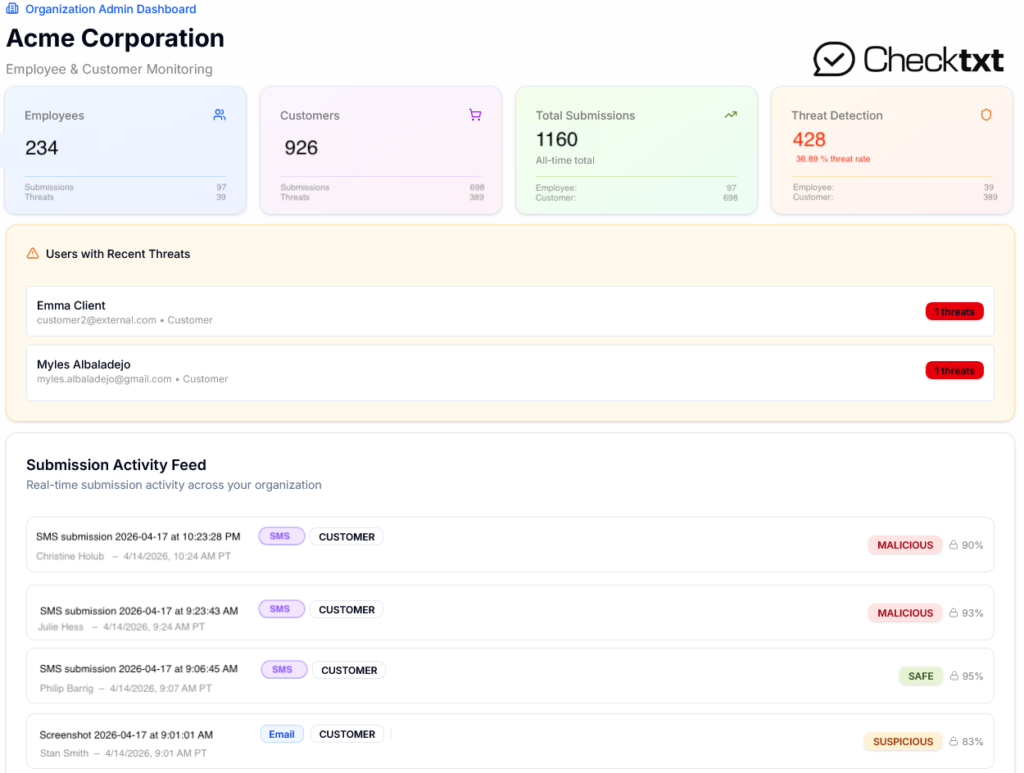
The CheckTxt Admin Dashboard gives bank fraud and security teams a live view into every suspicious message submitted across their customer base — not as an end-of-day report, but as it happens.
926 customers monitored. 389 threats detected. A 36.89% threat rate — visible in real time, not discovered after losses occur.
The Submission Activity Feed returns a Malicious, Suspicious, or Safe verdict with a confidence score in under 60 seconds, so your team sees the threat before the customer acts on it.
No aggregated reports.
No end-of-month summaries.
Just a live intelligence layer operating exactly where your existing security stack has no visibility: inside your customers’ messages.
Fraud detection is just a click away when you have the CheckTxt contact record
Phone: tap and contact will auto-save
Computer: Download the file → Open the file → Click “add” or “save”
Frequently Asked Questions
Does CheckTxt replace our existing security tools?
No. CheckTxt operates outside the traditional security stack, in the customer communication layer where existing fraud and security controls have no visibility.
It complements your current fraud, risk, and SIEM tools by detecting threats at the moment a customer receives a suspicious message — before any transaction occurs that your existing systems would flag. No workflow changes, no integration requirements, no displacement of current controls.
How do bank customers actually use CheckTxt?
Customers simply forward a suspicious text or send a screenshot to CheckTxt — no app download, no account, no onboarding needed.
CheckTxt analyzes the message in real time for impersonation signals, malicious links, urgency cues, and sender anomalies, then provides a clear verdict in under 60 seconds. CheckTxt works on any device and carrier, making it easy to extend protection to your entire customer base without extra support.
What does a bank actually see and get access to?
CheckTxt is a messaging security platform that gives fraud and security teams real-time visibility into SMS-based attacks targeting their customers, not just isolated incident reports. As customers forward suspicious messages, CheckTxt correlates these submissions across the customer base to detect coordinated impersonation campaigns as they develop. This allows your team to identify emerging attack patterns early enough to issue proactive customer advisories, rather than discovering a campaign only after losses have occurred.
How does CheckTxt support regulatory and compliance requirements?
Regulators are increasingly expecting financial institutions to demonstrate proactive consumer protection rather than just reactive reimbursement.
CheckTxt offers a documented, active control at the customer communication layer, showing examiners that your institution intercepts impersonation fraud before customers are harmed. Additionally, CheckTxt reduces the number of fraud complaints and customer harm incidents that often attract regulatory scrutiny.
How quickly can CheckTxt be deployed for a bank's customers?
CheckTxt requires no customer apps, accounts, or onboarding, and no changes to bank workflows or internal systems. Because CheckTxt operates outside the enterprise stack — directly in the customer communication layer — deployment isn’t dependent on IT integration timelines. Banks can quickly extend CheckTxt protection to customers without adding support burdens on internal teams.