
CheckTxt has identified a new SMS-based phishing campaign targeting individuals with what appears to be an official California toll violation notice. The message contains an image of a document titled “Notice of Civil Infraction Hearing – Toll Violation” that claims to come from the Superior Court of California, County of Los Angeles.
At first glance, the notice looks convincing. It resembles a legal document and states that payment for a toll violation has not been received. The message instructs the recipient to either appear in court or admit responsibility and pay the charge immediately. A QR code included in the notice directs the recipient to submit payment.
The message is fraudulent.
Security analysis indicates that the document is being distributed as part of a smishing campaign, a form of phishing delivered through fraudulent SMS text messages that attempts to trick recipients into sending money or revealing personal information.
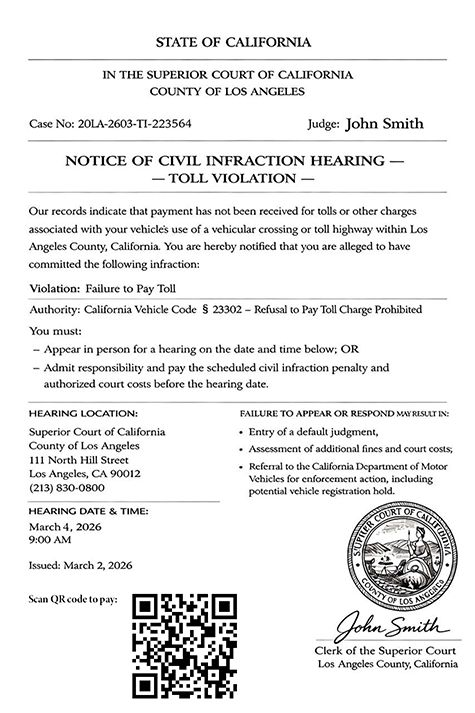
Example of a fraudulent “Notice of Civil Infraction Hearing – Toll Violation” circulating through SMS messages
How the Toll Violation Text Scam Works
The attack follows a pattern commonly used in smishing campaigns.
Typically, the victim receives a text message containing an image of what appears to be an official notice. The document claims a toll violation has not been paid and warns that the recipient must either appear in court or resolve the issue immediately.
To resolve the issue, the notice instructs the recipient to scan a QR code and submit payment.
By presenting the message as a legal issue involving a court hearing, the attackers attempt to create urgency and pressure victims into responding before verifying the request.
Warning Signs That the Message Is a Scam
Several elements of the message indicate it is not legitimate.
Common red flags include:
• Courts do not send legal notices through random SMS messages
• Payment is requested through a QR code
• Messages are sent from multiple phone numbers
• The notice creates urgent pressure to act immediately
• Payment destinations may be outside California
These characteristics are typical of smishing campaigns impersonating trusted institutions.
If you receive a toll violation notice through a text message asking you to scan a QR code or submit payment:
• Do not scan the QR code
• Do not send payment
• Delete the message immediately
Do not rely on links or instructions contained in an unsolicited message.
Protection from smishing where it actually happens—outside your security stacks
Not sure if the message you received is real? This is exactly what checking it looks like. CheckTxt CEO Jack Marshall analyzes this toll violation smishing scam live — verdict returned in under 60 seconds.
Why Smishing Attacks Like This Work
Text message scams are especially successful because they exploit how people communicate with their phones.
Unlike email, which many people handle cautiously, text messages are often read immediately and seen as more trustworthy. Attackers take advantage of this by impersonating organizations people recognize, such as banks, delivery companies, or government agencies.
In this case, using legal language and a court document adds credibility, while the threat of fines or legal consequences pressures people to act quickly.
Phishing and Smishing Attacks Are Surging
The toll violation message circulating now is not an isolated scam. It is part of a much larger wave of phishing and SMS-based fraud targeting consumers worldwide. Research from the Global Anti-Scam Alliance (GASA) shows that 7 out of 10 people experienced at least one scam attempt in the past year, underscoring the widespread nature of these attacks.
SMS messaging has become a preferred channel for attackers because of its high engagement rates. Text messages are typically opened within minutes of being received, making them an effective vehicle for social-engineering attacks.
Many smishing campaigns impersonate trusted organizations such as banks, delivery services, or government agencies. Bank impersonation attacks in particular have become one of the fastest-growing threats facing financial institutions and their customers.”
The fraudulent toll violation notice currently circulating through SMS is another example of how these campaigns continue to evolve.
How CheckTxt Helps Prevent SMS Fraud
Smishing attacks like the fraudulent toll violation notice succeed because they reach people at the exact moment they must decide whether to trust a message. Attackers rely on urgency, impersonation, and convincing formatting to pressure victims into acting quickly.
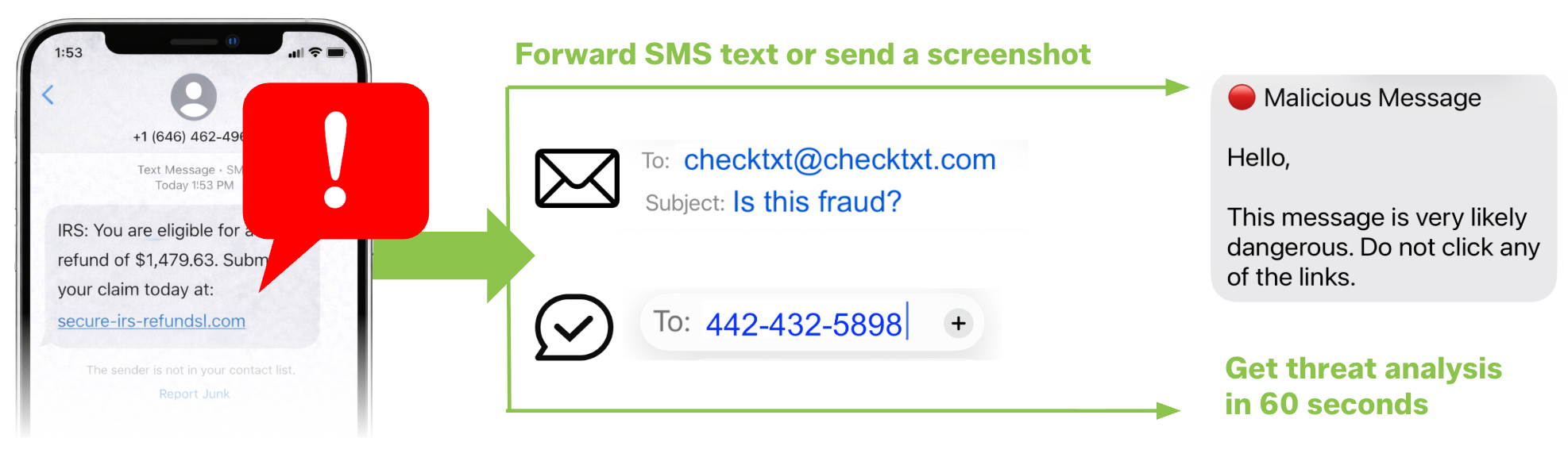
CheckTxt helps close that trust gap by giving individuals and organizations a simple way to verify suspicious messages in real time. Instead of guessing whether a message is legitimate, users can forward the SMS or send a screenshot to CheckTxt, where the message is analyzed for indicators of fraud.
By identifying impersonation attempts and suspicious messaging patterns early, CheckTxt helps people pause, verify, and avoid costly scams before money or personal information is lost.
As SMS fraud continues to grow, the ability to quickly determine whether a message can be trusted is becoming an essential part of everyday digital safety.
Users can forward suspicious texts or screenshots to CheckTxt to receive rapid analysis. Learn more about how CheckTxt analyzes suspicious messages and identifies indicators of fraud.
Report Suspicious Messages to CheckTxt
If you receive a suspicious SMS or email message, you can submit it to CheckTxt for rapid analysis.
- Forward a text or send a screenshot → 442-432-5898
- Forward an email or send a screenshot → [email protected]
CheckTxt analyzes suspicious messages and identifies fraud indicators in under 60 seconds, helping determine whether a message is legitimate or part of a fraud campaign.
Frequently Asked Questions (FAQs)
Is the California toll violation text message legitimate?
No. Messages claiming to be a “Notice of Civil Infraction Hearing – Toll Violation” sent through SMS are very likely fraudulent.
Courts and government agencies do not send legal notices requesting payment through random text messages. Official notices of toll violations or court hearings are typically delivered by mail, via official toll authority websites, or through formal legal service procedures.
If a message demands payment through a QR code or urgent link, it should be treated as suspicious.
Do courts request payments through QR codes?
No. Legitimate courts and government agencies do not request payments through QR codes sent in text messages.
Official toll violations are typically handled through:
mailed notices
official toll authority websites
verified government payment portals
A request to scan a QR code and pay immediately is a strong indicator that the message is part of a scam.
How can I verify whether a toll violation notice is real?
If you scanned the QR code or submitted payment, take action immediately.
You should:
• Contact your bank or payment provider and report the transaction as fraud
• Monitor your accounts for suspicious activity
• Report the scam to the Federal Trade Commission (FTC) or your local consumer protection agency
• Change passwords if you entered personal information on a suspicious website
The faster fraud is reported, the better the chances of limiting financial damage.
How can I verify whether a toll violation notice is real?
The safest way to verify a toll violation is to contact the toll authority directly using official contact information.
Avoid using any links, phone numbers, or QR codes provided in the text message.
Instead:
• Visit the official toll authority website
• Search for your vehicle or violation through the official portal
• Call the toll authority using the number listed on the official website
• Forward the message to [email protected]
If a legitimate violation exists, it will appear in the official system.
This isn’t an isolated incident
Recent warnings from government agencies and consumer protection organizations highlight the growing number of scams impersonating toll violations and court notices.
Michigan Attorney General warns of toll road scam impersonating court notice
Michigan officials warned residents about fraudulent messages claiming to be a “Notice of Civil Infraction Hearing” related to unpaid toll violations. The scam threatens legal consequences and directs recipients to resolve the issue immediately. Authorities confirmed the messages are fraudulent and advised residents not to respond or send payment.
https://www.michigan.gov/ag/news/press-releases/2026/03/02/ag-nessel-warns-residents-of-new-toll-road-scam-impersonating-36th-district-court
Maryland Judiciary warns about text message court scams
The Maryland court system issued a public warning about scam text messages claiming recipients had unpaid toll violations or court obligations. Officials emphasized that courts do not send text messages requesting payment or personal information.
https://www.mdcourts.gov/media/news/2026/pr20260226
Federal investigators warn about nationwide toll smishing campaigns
Investigations have uncovered large-scale smishing campaigns impersonating toll collection systems across the United States. These scams often use text messages directing victims to fraudulent payment websites.
https://apnews.com/article/c2948f44b810d5160b60738b95486ae9
FTC consumer alert about unpaid toll text scams
The Federal Trade Commission warns that text messages claiming unpaid toll fees are a common scam tactic. The FTC advises consumers not to click links or submit payment through unsolicited messages.
https://consumer.ftc.gov/consumer-alerts/2025/01/got-text-about-unpaid-tolls-its-probably-scam
Sources & Further Reading
Global Anti-Scam Alliance (GASA). State of Scams in the United States – 2025. https://www.gasa.org/state-of-scams/
Aspen Institute Financial Security Program. https://www.aspeninstitute.org/programs/financial-security-program/