
What a Pig Butchering Scam Really Looks Like
The scam that slips through all your security filters
It starts with a text that looks like a wrong number. A friendly hello, a little conversation, and over the following weeks, a relationship takes shape. By the time the talk turns to a can’t-miss crypto investment, the target trusts the person on the other end completely. This is pig butchering, the patient, multichannel scam that cost Americans $7.2 billion last year. It is built to slip past every defense a bank has, because it never looks like an attack until the money is gone.
What pig butchering is
Pig butchering takes its name from a grim metaphor. The Chinese term, Sha Zhu Pan, describes fattening a pig before slaughter. The scammer spends weeks earning a target’s trust, the fattening, before draining every account they can reach, the slaughter. It is not a single fraudulent message. It is a relationship, manufactured and patient.
The FBI is blunt about who runs these operations. In its 2025 Internet Crime Report, cryptocurrency investment fraud, the category that captures most pig butchering, was the single largest source of financial losses to Americans last year, at $7.2 billion. The Bureau attributes the bulk of it to organized criminal enterprises based in Southeast Asia that use victims of human trafficking as forced labor inside scam compounds. The people sending the messages are often captives themselves.
The anatomy of a scam
Pig butchering rarely begins where it ends. The FBI notes that contact usually starts with a text message, a social media note, or a message on a dating app, then moves quickly to a private messaging platform. The Global Anti-Scam Alliance found that text was the single most common channel through which Americans encountered scams over the past year, just ahead of email and phone calls (source: www.gasa.org). From there, the conversation follows a recognizable arc.
It opens innocently. A wrong number, a friendly hello, a photo. Over days and weeks, the exchange becomes a genuine-feeling connection. Then, almost in passing, the other person mentions an investment that has treated them well, usually crypto. They offer to help. The target is steered to a polished app showing steady, fake profits. Small test withdrawals work, which builds confidence. Larger deposits follow. When the target finally tries to pull real money out, the platform freezes, fees pile up, and the person they trusted disappears.
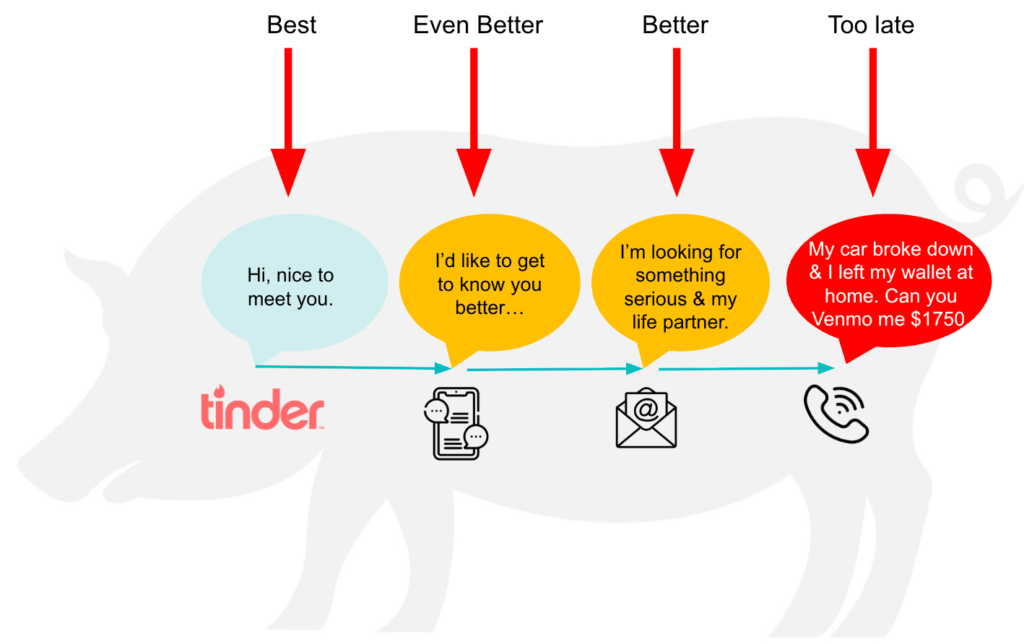
Figure 1. How a pig-butchering scam escalates across channels, from the first message to the final ask.
How a pig-butchering scam escalates across channels, from the first message to the final ask.
What makes it so effective is that no single message appears fraudulent. There is no malicious link in “Hi, nice to meet you.” The danger is the pattern, not the payload, and it unfolds across four or five channels before any money moves.
Each stage along that arc is a chance to step in, and the chance is greatest early. A check at the first friendly message is the best moment to catch it. By the time the request to send money arrives, it is usually too late.
The victim is a person, not a statistic
It is worth slowing down here. A pig-butchering victim is not a careless mark. In a large share of cases, they are someone moving through a hard season, such as a recent death, a divorce, or a stretch of loneliness. The companionship feels real because, to them, it is. When they mention the new relationship to friends or family, they are often met with suspicion or a quick dismissal. So they stop talking about it. The conversation with the scammer becomes the one place they feel they are not being judged, which is exactly what keeps them in it.
That dynamic, isolation paired with embarrassment, is the engine of the scam. It is also why warnings that arrive after the fact so rarely land.
Why existing defenses never see the scam
Banks have invested heavily in fraud controls, and most of them sit in the wrong place for this threat. Transaction monitoring catches anomalies once money is already moving. Email security guards the inbox. Network tools protect what happens inside the institution’s perimeter.
Pig-butchering happens outside all of it. The relationship lives on the customer’s personal phone, across consumer apps a bank has no visibility into. By the time a suspicious wire request reaches the fraud team, the customer has spent weeks being convinced the idea is their own. They will often defend the transfer because, in their mind, they are not being scammed; they are investing.
CheckTxt operates where the existing stack cannot: in the path of the messages a customer actually reads and trusts.
Each stage along that arc is a chance to step in, and the chance is worth the most early. A check at the first friendly message is the best moment to catch it. By the time the request to send money arrives, it is usually too late.
How CheckTxt helps prevent pig butcher scams today
Today, CheckTxt works on individual messages. A customer who feels a flicker of doubt, or a worried family member, can forward the suspicious text or a screenshot of the conversation and receive a clear verdict, Malicious, Suspicious, or Safe, in under sixty seconds. There is no app to install and no account to set up. See how CheckTxt works for your customers >
Pig butchering offers several moments where that check matters: the wrong-number opener, the unusually fast pivot to a crypto or investment opportunity, the screenshots of too-good-to-be-true profits, and the eventual request for money or a transfer. Any one of them can be verified the instant it arrives, which is the only window that counts, the one before the money leaves.
That neutral read matters more than it sounds. Many people in these situations are reluctant to raise their doubts with friends or family, who may judge them or wave the worry away. An objective verdict from a third party gives them something solid to act on before they send money, without the conversation they are dreading having.
Where is this going?
The harder problem is that pig butchering is not one message. It is a conversation that crosses a dating app, text, email, and a phone call, and its meaning only becomes clear when those moments are read together.
That is the problem CheckTxt is building toward. A new capability, in development now, is designed to read a conversation as a whole rather than one message at a time, drawing on signals such as reverse image lookups, employment verification, and analysis of how the conversation itself unfolds, to help judge whether the person on the other end is who they claim to be. The aim is to recognize a slow-building con as one continuous threat rather than a string of harmless-looking pings.
It is being built to work across the kind of unified, cross-channel conversation infrastructure that Twilio brought to market this year, the same shift now carrying legitimate customer conversations across voice, text, and chat. Scam detection has to follow the conversation to the same place.
Why this issue belongs on any bank or financial institution’s radar
A customer being slowly drained does not stay the customer’s problem. It surfaces as bank withdrawals, ban wires, reimbursement claims, and your brand exposure. Learn more about how CheckTxt prevents brand impersonation scams.
Regulators and law enforcement have taken notice. The FDIC’s Office of Inspector General has flagged the threat to institutions, the New York Attorney General issued a fresh consumer warning in early 2026, and the Department of Justice has stood up a Scam Center Strike Force aimed squarely at the Southeast Asian compounds behind these losses, an effort that has already notified thousands of victims and protected hundreds of millions of dollars.
Most fraud tools are built to catch a bad transaction after it happens. CheckTxt is designed to help prevent it. Banks that can warn customers before a transfer, rather than investigate after it, protect their members and their balance sheets at the same time. This is exactly what our customer-facing SMS fraud protection for banks is built for.
Frequently Asked Questions
What is a pig butchering scam?
A long-running fraud in which a scammer builds a personal or romantic relationship with a target over weeks, then convinces them to invest in a fake platform, usually crypto, before disappearing with the money. The name comes from the practice of fattening a pig before slaughter.
How does a pig butchering scam start?
Usually with an unsolicited message that looks like a wrong number or a casual hello, sent by text, social media, or a dating app. The scammer then moves the conversation to a private messaging app and builds trust long before money is ever mentioned.
Why don't normal bank fraud tools catch it?
Encourage them to stop sending money and to verify the conversation before acting. With CheckTxt, they can forward a suspicious message or screenshot and get a verdict in under a minute. Approach the conversation without judgment, since shame is what keeps many victims silent.
What should I do if I think a customer or relative is being targeted?
Because the scam lives on the customer’s personal device, across consumer apps a bank cannot see, and no single message looks fraudulent. Transaction monitoring only reacts once funds are already moving, by which point the customer often believes the transfer is their own decision.
Sources
FBI Internet Crime Complaint Center (IC3), 2025 Internet Crime Report — https://www.ic3.gov/AnnualReport/Reports/2025_IC3Report.pdf
Global Anti-Scam Alliance (GASA), State of Scams in the USA 2025 (source: www.gasa.org) — https://www.gasa.org/
FDIC Office of Inspector General, Pig Butchering Scams alert — https://www.fdicoig.gov/pig-butchering-scams
New York State Office of the Attorney General, consumer alert on pig butchering scams (Feb 2026) — https://ag.ny.gov/press-release/2026/attorney-general-james-warns-new-yorkers-about-pig-butchering-scams