
The 2026 Scam Data Every Bank Fraud Team Should See
Rising exposure, text-borne scams, and a growing belief that the bank should compensate fraud victims
Ask most Americans if they can spot a scam, and almost all of them say yes. Eighty-six percent are confident they can. The 2026 State of Scams report shows how little that confidence is worth: most people who ran into a scam last year engaged with it anyway, and two in three victims only learned they had been scammed after someone else told them. For banks, the harder finding sits a few pages later. Nearly half of Americans now say their bank should be the one to pay them back.
The scale of the problem
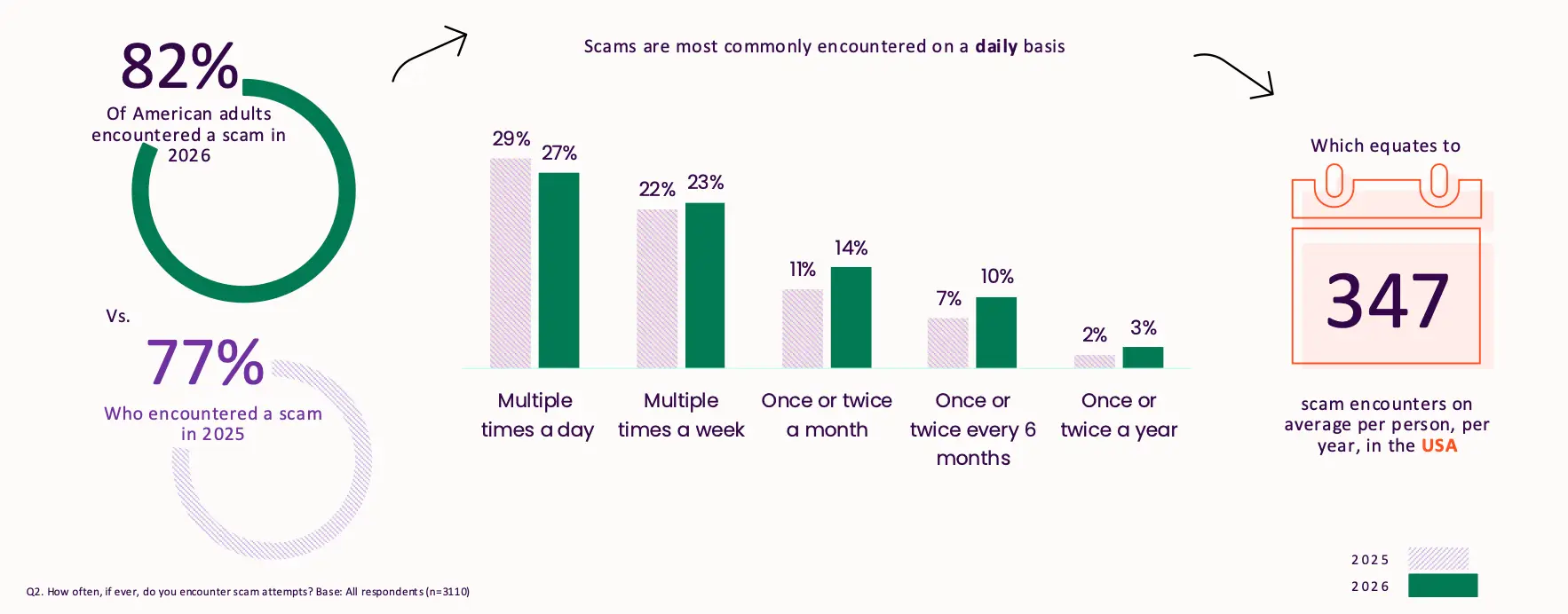
Scams are no longer an occasional threat that hits unlucky people. They are a constant, and the volume is staggering. The Global Anti-Scam Alliance found that 82 percent of American adults ran into a scam over the past year, up from 77 percent the year before. That works out to an average of 347 scam attempts per person, nearly one a day, every day.
Most of those attempts fail. The ones that land are expensive. Across the country, Americans lost an estimated $37.3 billion to scams in the past year, with the average victim out $1,541. Behind that number are roughly 24 million adults who handed money or information to someone they should not have trusted.
What makes the scale harder to manage is that people no longer catch these scams on their own. Two in three victims only realized they had been scammed after someone else told them, often their bank. When the people closest to the loss cannot see it coming, the institutions around them have to.
Figure 1. Scam data from the GASA 2026 State of Scams USA report: 82 percent of American adults encountered a scam in the past year, up from 77 percent, averaging 347 attempts per person.
Scams reach your customers beyond your traditional security stack
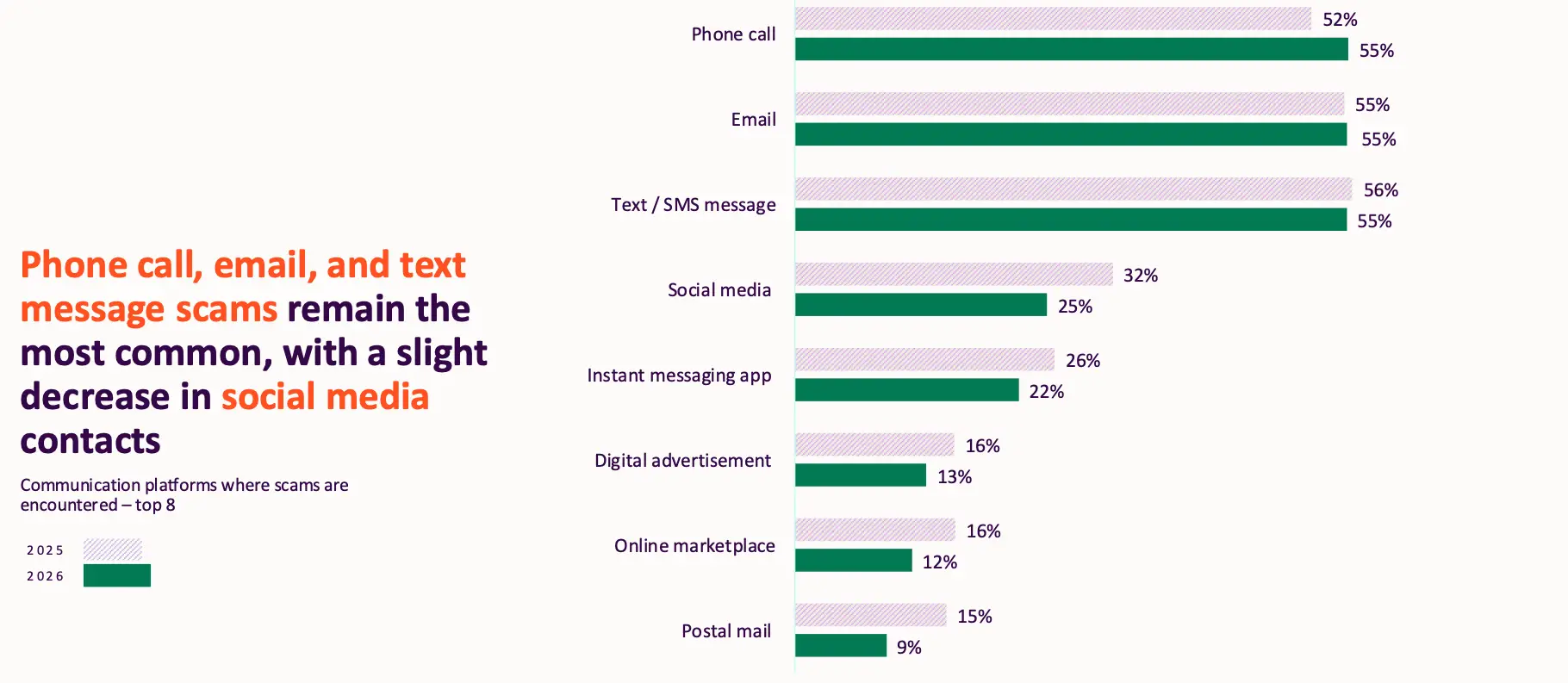
If banks are going to catch the scams their customers miss, it helps to know where those scams arrive. For most people, it is the phone in their pocket. Text messages were one of the three most common channels through which Americans encountered scams last year, level with phone calls and email, and ahead of social media, messaging apps, and every other route.
That is not an accident. A text feels personal and urgent. It lands in the same thread as messages from real banks and delivery services, and it carries none of the visual warning signs people have learned to spot in email. A fake toll notice or a suspicious-login alert looks exactly like the real thing on a small screen.
The wider pattern points the same way. 71 percent of all scam attempts reached people on platforms with a direct-message function, whether that is SMS, a messaging app, or a social inbox.
Scammers go where the conversation is private and the message feels one-to-one, and for most Americans, that starts with a text.
Figure 2. Scam data from the GASA 2026 State of Scams USA report: text message ranks among the top channels for scam contact, with 71 percent of attempts arriving on platforms that have a direct-message function.
Who Pays for Fraud When a Scam Succeeds
When a scam succeeds, someone absorbs the loss. Increasingly, Americans think it should be the bank. Nearly half now say banks should always be responsible for reimbursing scam victims, a level of expectation that used to sit with the person who got tricked, not the institution that held their money.
That expectation comes with permission to act. Two in three Americans support letting banks block a suspicious transaction, even without the customer’s approval in the moment. People are willing to trade a little friction for protection, and they are looking to their bank to provide it.
For fraud teams, this is the shift that matters most. The public is moving toward a world where preventing the loss is the bank’s job and covering it is the bank’s cost. That is already law in the UK, where banks are required to reimburse most authorized push payment fraud. The pressure to get ahead of scams, rather than investigate them after the money is gone, is only going to grow.
How CheckTxt Stops Text Scams Before Customers Act
The data points to one conclusion. Scams arrive via text; customers cannot reliably catch them, and the public increasingly expects the bank to bear the cost. That leaves banks needing to stop the loss at the one place their current tools cannot reach: the message itself, before the customer acts on it.
That is what CheckTxt does. A customer who gets a suspicious text can forward the message and get real-time fraud detection that returns a clear verdict, Malicious, Suspicious, or Safe, in under sixty seconds. There is no app to install and no account to create. The check happens at the point of delivery, in the moment the customer is deciding whether to trust what they are reading, which is the only window that reliably prevents the loss rather than documenting it afterward.
For a bank, that turns a text scam from an after-the-fact reimbursement claim into a message that never gets acted on. It puts SMS fraud protection for banks where the threat actually lands, and where consumers now expect the bank to be.
See how it works yourself, sign up for a personalized demo >>
Read the full report
This article highlights the findings most relevant to bank fraud teams, but the GASA State of Scams USA 2026 report covers considerably more, including how victims are targeted, which age groups are most affected, and how people respond after a scam.
The full report is available through the Global Anti-Scam Alliance. Access requires a GASA membership.
Frequently Asked Questions
How much did Americans lose to scams in the past year?
Americans lost an estimated $37.3 billion to scams over the past year, according to the Global Anti-Scam Alliance’s 2026 State of Scams report. The average victim lost $1,541, and roughly 24 million adults lost money. The report also found that 82 percent of American adults encountered a scam, an average of 347 attempts per person.
What is the most common way scammers reach people?
Text message is one of the three most common channels, level with phone calls and email. The GASA report found that 71 percent of all scam attempts reached people on platforms with a direct-message function, including SMS, messaging apps, and social inboxes. Scammers favor these channels because the message feels personal and one to one.
Do consumers think banks should reimburse scam victims?
Increasingly, yes. Nearly half of Americans, 48 percent, say banks should always be responsible for reimbursing scam victims, according to the GASA report. Two in three also support letting banks block a suspicious transaction without the customer’s approval in the moment.
About the Global Anti-Scam Alliance (GASA)
GASA is a nonprofit whose mission is to protect consumers worldwide from scams. It brings policy makers, law enforcement, consumer authorities, banks, telecom operators, and online platforms together to share intelligence and coordinate a response. Its annual State of Scams study is one of the largest consumer surveys on fraud in the world, covering 58,900 respondents across 42 countries. The figures in this article come from the US edition, a nationally representative survey of 3,110 American adults conducted in March and April 2026.
Sources
Global Anti-Scam Alliance (GASA), State of Scams in the USA 2026 — https://gasa.org/knowledge-base/reports/state-of-scams-in-in-the-united-states-of-america-2026
UK Payment Systems Regulator (PSR), APP scams reimbursement requirement (in force 7 October 2024; mandatory reimbursement of up to £85,000, split equally between sending and receiving firms) — https://www.psr.org.uk/media/rhelv4op/ps25-5-app-scams-reimbursement-consolidated-policy-statement-may-2025.pdf